Almost every data crisis starts the same way: someone opens a report, sees a weird number, and nobody knows whether the data is wrong or the business just changed. By the time they figure it out, the decision is already made.
A data quality rule exists to cut that story off at the root. It's an automated test that runs against your data and answers a concrete question — are there empty phone numbers in the customers table?, are there duplicate IDs?, are there top-ups with impossible amounts? — and warns you before the problem reaches a dashboard.
The good news: in OpenMetadata (open source, no licenses) creating your first rule takes under two minutes. We'll show you with real screenshots on a telecom database.
What a "quality rule" actually is
Think of it as a blood test for your data. You define an expected value ("the phone_number column must never be empty") and the platform checks it every time it runs. The result is binary and honest:
- 🟢 Pass — the data complies. You can trust it.
- 🔴 Fail — something broke. OpenMetadata opens an incident and notifies.
The key part: the rule stays attached to the table, documented and versioned. It's not a loose script on an analyst's laptop — it's governance.
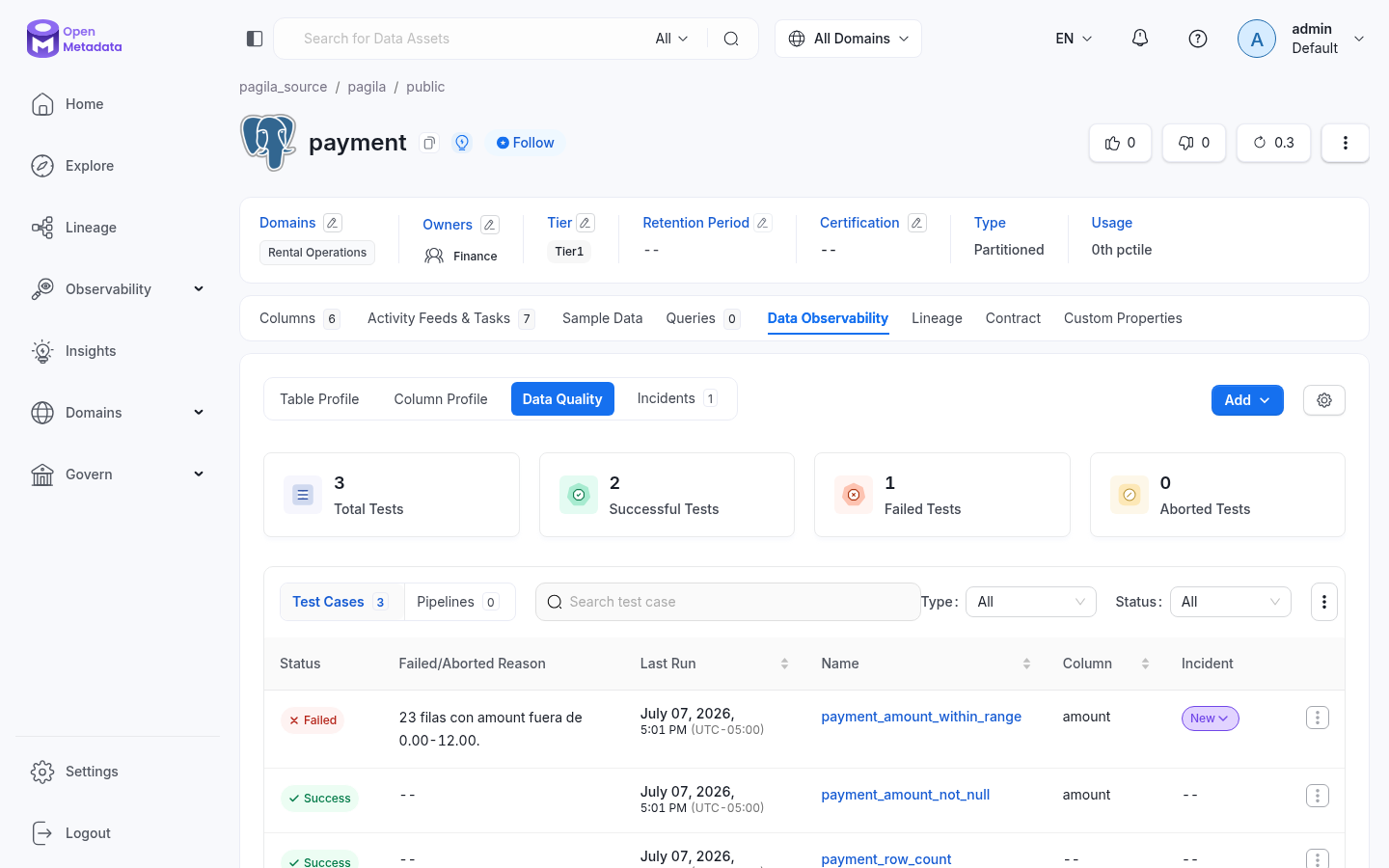
Step 1 — Open your table's quality tab
Open any table in your catalog and go to Data Observability → Data Quality. That's where all of the table's rules live: how many there are, how many pass, how many fail, and when they last ran.
In the example, the customers table already has two rules in green — customer_id unique and phone_number not null. That dashboard is what your team will see every morning.
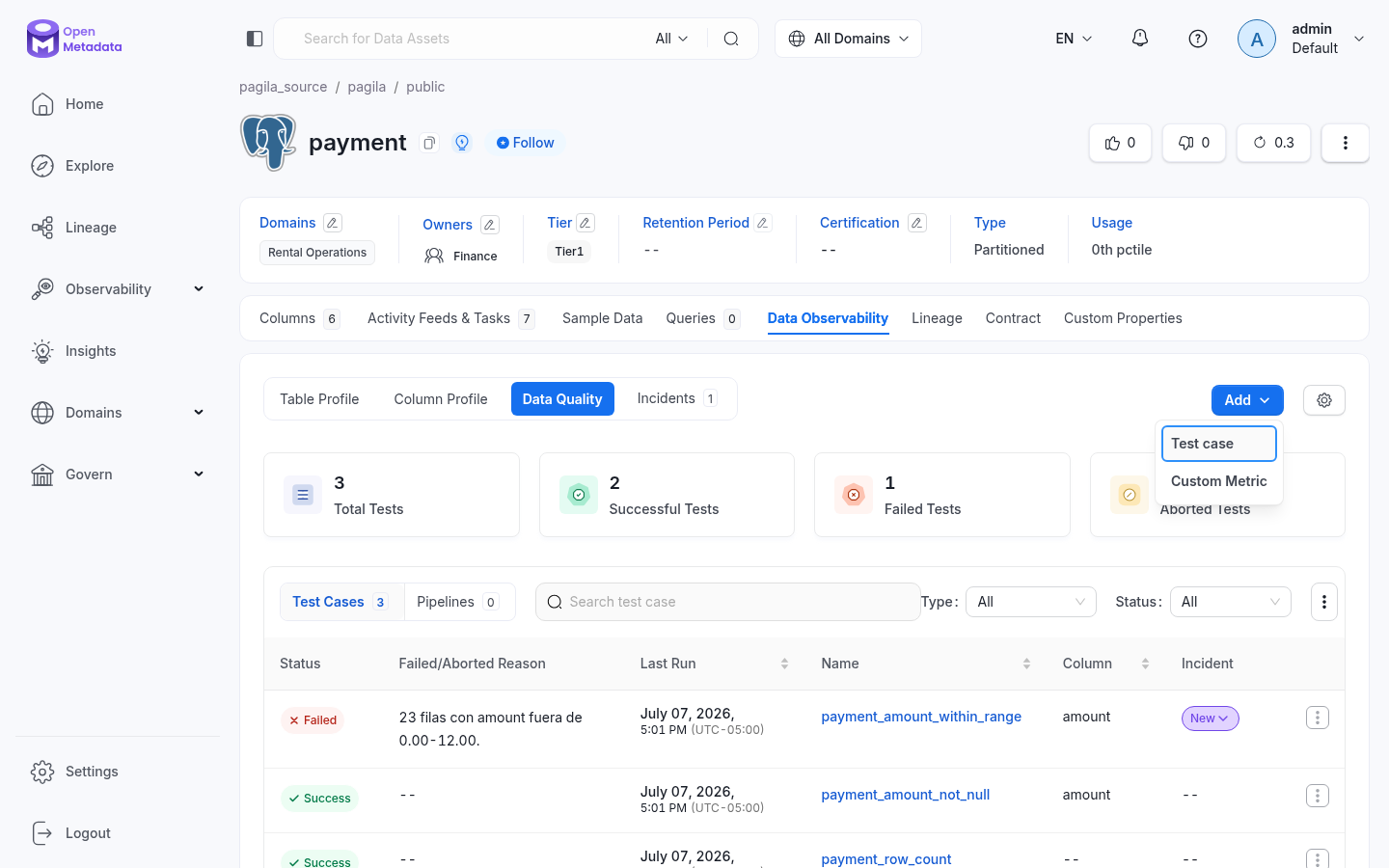
Step 2 — Click "Add → Test case"
Top right, the Add button opens the menu. Choose Test case to create a new rule.
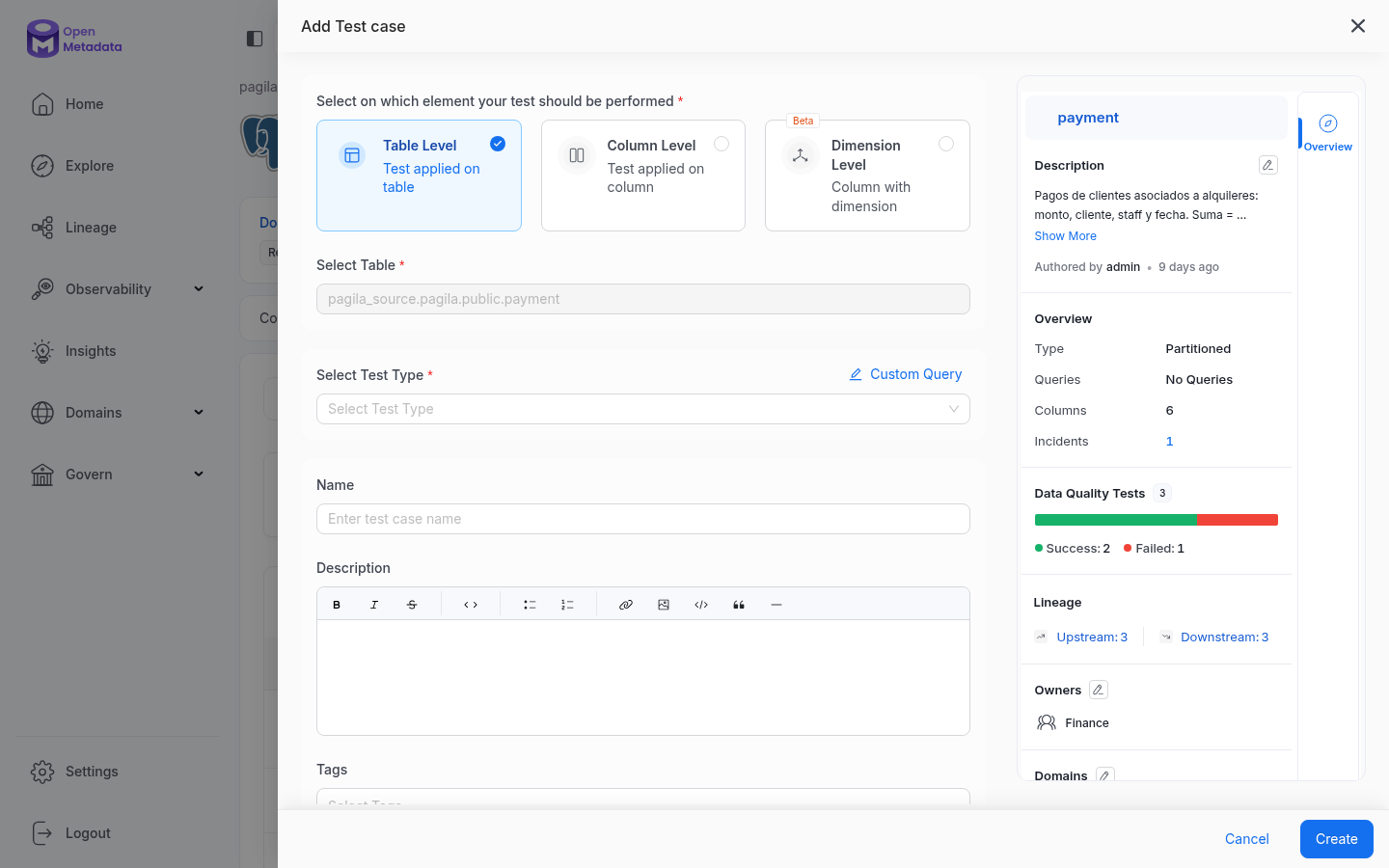
Step 3 — Pick the scope and the rule type
OpenMetadata opens a guided form. Just three decisions:
- What does the rule run on? At the table level (e.g. "row count must be between X and Y") or the column level (e.g. "this column allows no nulls").
- Which rule type? No SQL required: OpenMetadata ships a catalog of ready-made rules — values not null, values unique, values within a range, values matching a pattern (regex), row count, freshness, and more.
- Name it and hit "Create". Done.
The rule is created and runs — manually or scheduled — alongside the rest. Green or red, no ambiguity.
Where to start: 3 rules worth gold from day 1
Don't try to cover everything. These three catch the most expensive (and most embarrassing) errors:
- Unique IDs (
columnValuesToBeUnique) — on your master customer or product table. A duplicate ID poisons everything that joins to it downstream. - PII not null (
columnValuesToBeNotNull) — phone, email, document. A customer with no contact is a customer the business can't reach. - Amounts in range (
columnValuesToBeBetween) — top-ups, invoices, usage. Catches the classic $99,999 amount that pollutes your whole revenue.
With those three you already have a seatbelt on your most critical data.
This is data governance, not a patch
A single rule is useful. Dozens of rules, tied to tables with an owner, a glossary and lineage, running on their own and opening incidents — that's a mature data governance program. It's the difference between firefighting and trusting your numbers.
At GalacticaIA we implement exactly this on OpenMetadata — catalog, lineage, quality and policies — until your governance is operational, with 15+ years of real Telecom and Fintech experience across LATAM.
Want to know where your organization stands? Start with a data maturity assessment or see how we approach OpenMetadata implementation.