Portfolio

Five practices that turn data into business decisions

We are an integrated, software-agnostic data consultancy. We connect strategy with the platform, models, commercial intelligence, and agentic systems that put each decision into operation.

You enter through the problem you need to solve. No practice is a prerequisite for another, and each engagement brings in only the cross-cutting capabilities it needs.

The five practices

01 · Direction, operating model and trust

Data Strategy & Governance

We translate business priorities into an executable data strategy and the governance model that sustains it. We combine roadmaps, operating models, ownership, quality, policy and adoption with DAMA-DMBOK and DCAM where they apply.

Problems we solve

Scattered initiatives, competing metrics, decisions with no accountable owner, and data that cannot withstand scrutiny.

Outcome

Clear priorities, operable accountability, and an investment path tied to business decisions.

Deliverables

  • Capability assessment and roadmap prioritized by value, risk and feasibility
  • Data strategy, architecture principles and operating model
  • Roles, decision forums, policies and ownership for domains and data products
  • Catalog, lineage, quality and critical definitions in operation
  • Adoption, training and metrics that track program progress

From priority to operable capability

Strategy defines what to move; governance makes it sustainable

Priority

What the business needs

  • Growth and experience
  • Efficiency and productivity
  • Risk and trust
  • New data products

Strategy

Which capability is needed

  • Prioritized use cases
  • Target architecture
  • Roadmap and investment

Operating model

Who decides and delivers

  • Owned domains and products
  • Forums with explicit authority
  • Roles and ways of working

Control

How it stays in place

  • Quality and critical definitions
  • Applied, traceable policies
  • Adoption and progress metrics

Decision traceability

Each priority connects to a capability, an owner, an investment and a measure of progress. Governance is not a toll gate; it is the accountability system inside this practice.
02 · Data architecture and engineering

Data Platforms & Lakehouse

We build the platform where the data lives: layers, sources, ingestion, reconciliation, processing engines and storage, on the cloud you already have. Designed so that migrating later does not mean starting over.

Problems we solve

Isolated sources, fragile pipelines, unpredictable costs, and teams rebuilding the same table again and again.

Outcome

A scalable, observable platform that serves reliable data to analytics, products and AI.

Deliverables

  • Layered architecture —landing, curation, consumption— with explicit promotion criteria between them
  • Ingestion and reconciliation of the sources the business actually uses every day
  • Storage model and table format, chosen for what you are going to query
  • Traceable migration plan from what already exists, without turning off what is in use
  • Storage and compute cost optimization

The platform, from the inside

Where data lands, what it takes to move up a layer, and what it all runs on

Sources

  • Core business systems and ERP
  • Application events and digital channels
  • Files, spreadsheets and external providers
  • Documents and unstructured data

The layers, and what it takes to move from one to the next

Landing

Raw

Data arrives exactly as the source has it, untouched. If it has to be reprocessed tomorrow, it is reprocessed from here.

  • Faithful copy of the source
  • Full history

To move up: the schema is declared and the load can be repeated without duplicating.

Curation

Reconciled

Names, dates and keys aligned across systems; duplicates resolved by a written rule, not by hand.

  • Keys reconciled across systems
  • Types and units normalized
  • Quality rules that run on every load

To move up: the quality rules pass and there is an owner who answers for the table.

Consumption

Data products

Tables with an agreed definition, ready for the business and for models to use without recomputing them every time.

  • One definition per metric
  • Served to dashboards, models and APIs

Who queries it

  • Dashboards and reporting
  • Models and experimentation
  • Applications and APIs

What it runs on

  • Object storage
  • Open table format
  • Query engine decoupled from the data

The data lives in open storage and the engine that queries it is chosen separately: you can swap the engine without moving the data, which is what keeps you from being locked to a vendor. It is also where the bill is decided — how it is partitioned and compacted weighs more on cost than which engine you pick.

03 · Models, experimentation and optimization

Advanced Analytics & Machine Learning

We design analytical solutions that explain, predict and optimize decisions. The work spans framing and experimentation through modeling, temporal validation, deployment and monitoring.

Problems we solve

Unreliable forecasts, manual decisions that do not scale, and models that never reach production or cannot be validated.

Outcome

A quantified decision, a model evaluated against a clear baseline, and a mechanism to operate and monitor it.

Deliverables

  • Forecasting, propensity, classification, scoring and anomaly detection
  • Optimization models and scenario simulation
  • Experiment design and causal measurement
  • Feature engineering, temporal validation and explainability
  • Deployment, performance monitoring and retraining where appropriate

From problem to operable decision

A model earns its place through the decision it improves and how it behaves after launch

01 · Frame

Define the decision

We agree which action will change, for whom, and under which constraint.

  • Target and horizon
  • Error cost and baseline
  • Success criterion

02 · Model

Build and validate

We train against the past without leaking information from the future.

  • Reproducible features
  • Temporal split and backtesting
  • Explainability and bias

03 · Operate

Prioritize the action

The score becomes a queue, rule, forecast or scenario that someone uses.

  • Thresholds and constraints
  • Action and owner
  • Workflow integration

Validation

Model and business metrics are reported together, compared with a baseline and with the cost of getting it wrong.

Monitoring

Performance, drift, feature quality and action outcomes are observed after deployment; the model is not left behind.

04 · Customers, marketing and digital channels

Customer & Digital Intelligence

We turn customer and digital-channel signals into measurable commercial actions: who to prioritize, what to offer, which experience to fix, and which intervention actually caused a change.

Problems we solve

Segments that never drive action, campaigns measured by correlation, opaque funnels, and competing versions of customer behavior.

Outcome

Growth and retention decisions with audiences, actions, owners, and causal measurement when the case supports it.

Deliverables

  • Actionable segmentation: each segment with its behavior, risk, eligible offer and action
  • Churn prediction trained only on what was known at the time, prioritized by customer value
  • Next-best-offer, already filtered by who is allowed to receive it and who gave permission to be contacted
  • Digital funnel and journey with quantified friction points
  • Campaign incrementality and end-to-end digital ecosystem measurement
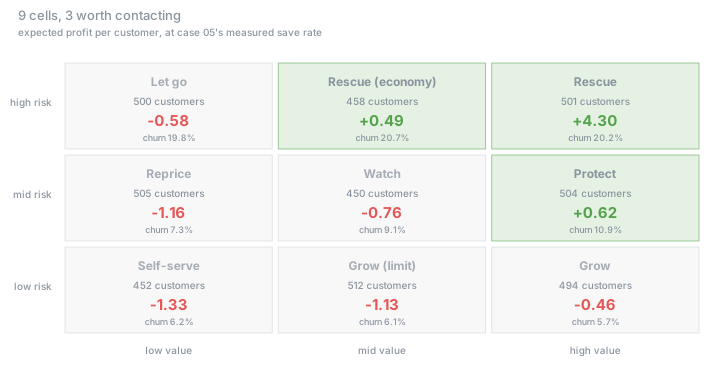
A nine-segment grid by risk and value; each cell shows size, churn and expected profit per customer. Only three cells have positive value

Drag → the segments that pay for the contact are on the right

Actionable segmentation: nine cells with behavior and economics. Only three pay for the contact; deciding who not to call is part of the deliverable too. Reproducible artifact over synthetic data.See code, data and tests(opens in a new tab)
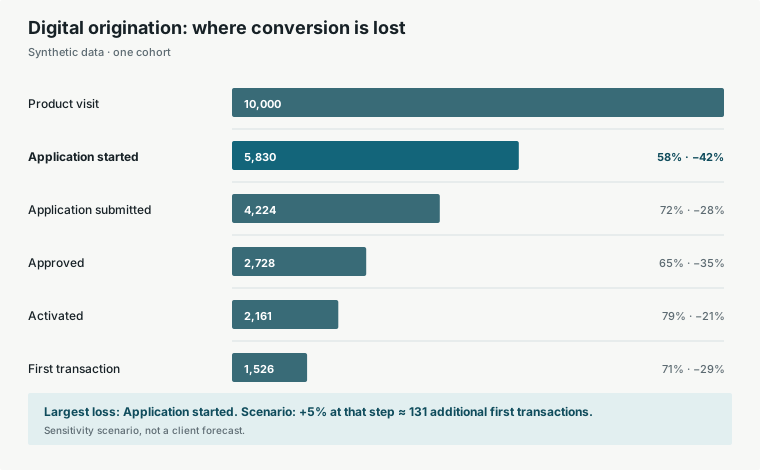
Digital-origination funnel from product visit to first transaction, quantifying conversion and loss at every step

Drag → conversion and loss appear at the end of each step

Digital Analytics: the funnel locates the largest loss and translates a five-point improvement into additional first transactions. This is a sensitivity scenario over synthetic data, not a client forecast.See code, data and tests(opens in a new tab)

05 · Agentic systems and operable products

Agentic AI & Data Products

We design data products and agentic frameworks that bring intelligence into the workflow. We define tools, memory, evaluation, observability and authority boundaries so the system is useful and controllable.

Problems we solve

AI prototypes disconnected from the business, agents with unclear limits, and analytics that never enters the workflow where decisions happen.

Outcome

An operable product with users, a data contract, quality criteria, and an explicit boundary between automation and human decisions.

Deliverables

  • Data AI-readiness assessment
  • Data-product design, consumers, contract and service level
  • Agentic framework with tools, memory, evaluation and observability
  • Decision flow with human approval and a full trail

Who decides, and who prepares the decision

The fleet reports to a person, and the person sits outside the fleet

Human authority · outside the automated loop

A person decides

Sets the objective, deliberates with the evidence gathered, and authorizes. No agent coordinates them, and none can bypass them.

Authority boundary · only what needs judgement goes up

Orchestrator

Coordinating agent

Takes the objective, distributes it across the relevant agents, gathers what each contributes along with its source, and synthesizes it into a traceable recommendation.

It neither approves nor executes. What does not need judgement is resolved below and never reaches the person; what does, goes up with the evidence behind it.

Catalog

Inventory agent

Finds what data exists, describes it, and keeps it current when the source changes.

Its sources

Source-system metadata, catalog, schema history

Reports to the orchestrator

Classification

Personal-data agent

Proposes which columns are personal data and of what kind, for a person to confirm.

Its sources

Data samples, known patterns, previously validated classifications

Reports to the orchestrator

Policy

Rule-enforcement agent

Checks actual usage against declared policy and raises a flag when they do not match.

Its sources

Standing policies, access logs, quality and retention rules

Reports to the orchestrator

Trail

What data went in, which agent touched it, with what source, what it recommended and who decided — with a date and an owner, case by case. Without that, the decision cannot be defended six months later, which is when it gets questioned.

COMMERCIAL EVIDENCE

Work that moved a decision

Client work is anonymized and carries no figures we cannot substantiate. Synthetic artifacts and technical implementations appear separately: they prove method and scope, not a company's results.

Data Platforms & Lakehouse

Telecommunications operator · LATAM

Problem
A SaaS data-warehouse architecture under cost pressure, and a migration that could not lose traceability.
Intervention
Design and delivery of the move to a lakehouse, incorporating lineage and control over the data journey.
Visible deliverable
Target architecture, migration plan, lineage map and cloud-optimization baseline.
Decision or outcome enabled
The organization could move the platform through a verifiable path and reduce the structural cost of its data operation.
Customer & Digital Intelligence

Telecommunications operator · LATAM

Problem
Marketing needed to prioritize audiences through a consistent reading of customer behavior.
Intervention
Statistical user segmentation and translation of the groups into criteria campaign teams could use.
Visible deliverable
Documented segments, assignment rules and an actionable reading for marketing.
Decision or outcome enabled
The segments moved into campaign management instead of remaining a descriptive view.
Data Strategy & GovernanceIn progress

Healthcare organization · Chile

Problem
The new data-protection law requires knowing which personal information exists, why it is used and who is accountable.
Intervention
Design of the governance model, personal-data inventory and accountability for its processing.
Visible deliverable
Personal-data map, ownership, policy and an evidence matrix for operating compliance.
Decision or outcome enabled
An operating basis for privacy decisions with accountable owners and traceable evidence.

TECHNICAL PROOF

Explanatory, reproducible and implemented are not the same thing

The five practice diagrams explain how we think. These pieces go further: they let you inspect code and tests, or define the boundary of a capability already implemented.

Reproducible artifact

Advanced Analytics & ML

A synthetic fintech suite covering out-of-time churn validation, actionable segmentation, next-best-offer, customer value and campaign incrementality.

Seeded causal data, versioned outputs and 110 tests covering leakage, integrity and reproducibility.

Inspect the lab(opens in a new tab)

Reproducible artifact

Digital Analytics

An origination funnel from product visit to first transaction, with loss at each step and a sensitivity scenario around the bottleneck.

ES/EN SVGs from one run; tests bind the step catalog to every synthetic event.

See the funnel case(opens in a new tab)

Implemented capability

Agentic AI

A conversational agent over data catalogs with MCP read and write operations, tool traces and confirmation before assets are changed.

Verifiable scope: 27 catalog operations, dry-run mode, human confirmation and an audit log.

See the operating scope

Two ways to start

If you already know what your problem is, write to us directly. If you don't know where to start, the self-assessment places you.

Tell us about your case

You tell us the problem. We tell you whether it's ours, how we'd approach it and what we'd need from your side. No questionnaire first.

Write to GalacticaIA

Data maturity self-assessment

Questions about the state of your data. At the end you get your maturity level and what to move first.

Take the self-assessment